case study
AI-native trial activation
I redesigned the trial onoarding that drove a 1232% stat-sig increase in core AI agent engagement and +14% trial win-rate
Role
Design lead
Partners
Product, content, engineering
Timeline
77 days to pilot experiment;
6 months of 8 iterative experiments
Results
+14% Win-rate
+1232% AI engagement
snapshot

I designed an onboarding flow that compressed AI agent's time-to-value. Our pilot experiment drove a 1,232% stat-sig lift in AI engagement and a +14% trial win-rate.
Less than 1% of trialists were exposed to the core AI agent feature because of poor discovery and complex set up. I designed an onboarding experience that used generative AI to remove the user lift required to see an AI agent in action, answering real questions a business receives.
A year later and this work has sustained a 710% increase in AI usage within trial, a 1,070% increase in trial go-live rates and a 189% increase in AI penetration in the first 30 days post-purchase
how it started
The flagship AI agent feature was effectively invisible during trial. That needed to change fast.
Zendesk needed to feature AI Agents Essentials in the trial experience by end of September—giving new trialists a reason to engage with AI while making a technically complex setup feel approachable and trustworthy. The existing path required deep product knowledge, multiple configuration steps, and offered little reassurance for users unfamiliar with AI agents. The result: low engagement and a missed opportunity to demonstrate Zendesk's AI capabilities during the most critical window of the customer journey.
how i approached it
Identify the hook:
What is AI agent's most impactful aha moment?
Not all aha moments are created equal—the right one had to resonate with trialists, align with business priorities, and be technically feasible to deliver in trial. I prioritized identifying the single moment most likely to shift a trialist's perception of AI agents.
Fast-track to value:
Reduce friction so users see the value quickly
With the hook defined, I restructured the flow to get trialists to that moment within minutes of their trial. I removed points of friction that stood between a new user and their first meaningful AI interaction. Progressive disclosure, smart defaults, and AI APIs replaced the complexity that was causing early drop-off and low discovery.
Execute with velocity:
Focus design work on the core hypothesis
Business goals put pressure on fast delivery. With a short timeline, I focused on one core hypothesis and used that to ruthlessly prioritize the scope of the first experiment and conduct design discovery and validation in parallel with engineering partners. I also leaned heavily on prompt-based prototyping to rapidly prototype through rounds of research and iteration.
key solution
Trialists can see AI agents in action just from a single action
Rounds of testing highlighted that seeing AI agents answer commonly asked questions left the best impression on trialists. In 3 weeks, I explored and tested several ways facilitate this aha moment in the first few minutes of the trial journey.
Version 1: What if trialists see value from a single click?
I first explored a design that only needed one click from the user to see how an AI agent might answer a question. I wanted to use categories curated from common topics across B2C, B2B, and B2E companies. Users are able to choose a topic and we will have sample knowledge in the background that the AI agent will use as its knowledge source.
While it offered a low barrier of entry to see how AI agent works, it led to lackluster reactions from test participants. They sped through the experience without showing signals of likeliness to keep learning about AI agents.

Version 2: What if trialists can bring their own trusted knowledge?
The breakthrough came when I shifted from canned AI responses to letting trialists add their own information and see AI agents answer real questions immediately. In testing, this was the moment it clicked: users saw that just one sentence of knowledge could make AI agents effective.
The launched experiment showed strong engagement from trialists who provided information, but many struggled with what to give and how much. Despite this friction, the data validated the core hypothesis: experiencing personalized AI responses drove engagement. We shipped it and optimized from there.

Version 3: What if from one source we can infer as much knowledge as possible?
This version was the culmination of cross-functional collaboration towards the possibilities with using generative AI services. Since trialists were having trouble getting a quick understanding of what to give us, I designed this experience that only needed their website url, and from there we orchestrate ways to infer and generate knowledge sources behind the scenes. TLDR: give a website, we'll choose the best pages to train your AI agent on and generate knowledge sources!

Reassure trialists that they can experiment with AI agents safely during trial
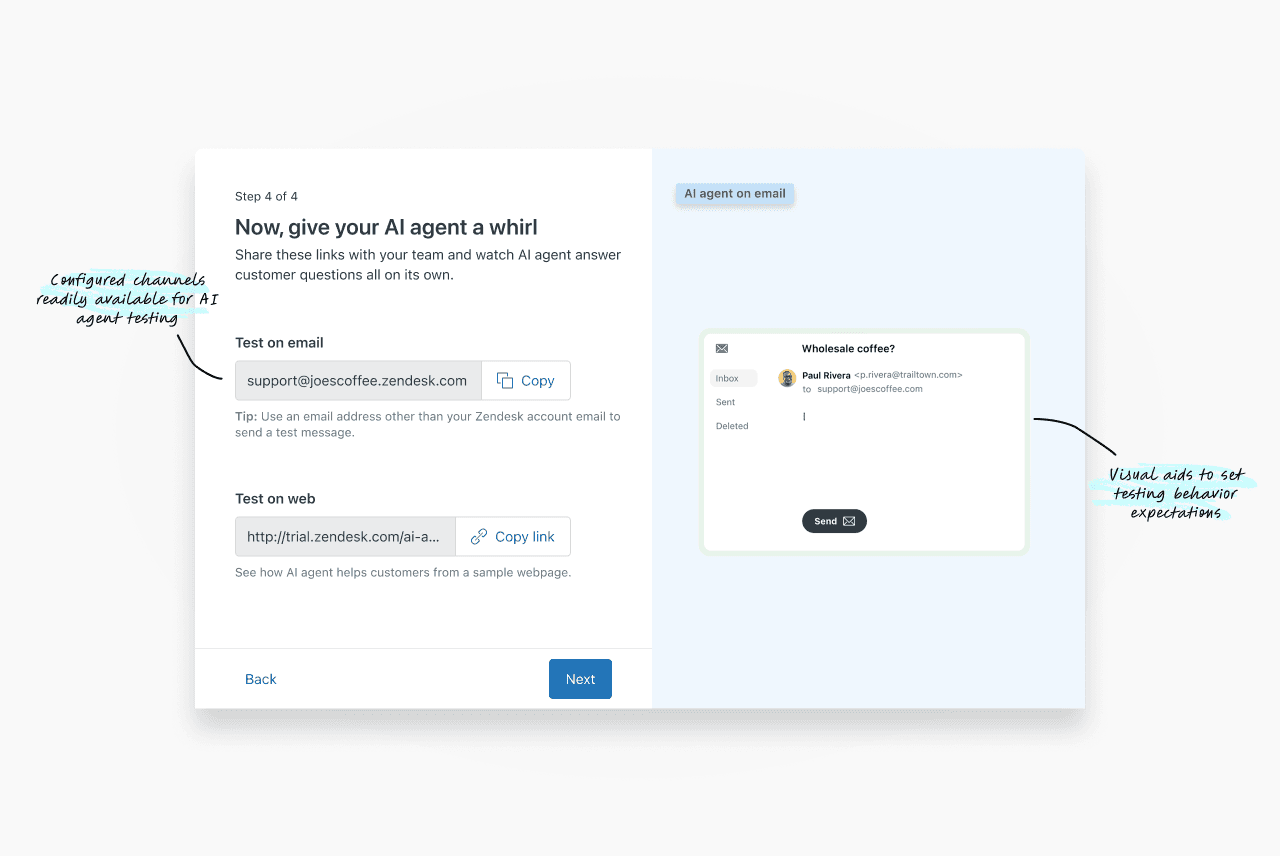
We created pre-configured email and web channels to give trialists safe, isolated environments to test AI agents immediately. Users could send test emails or interact through a private, dedicated URL without worrying about impacting production systems. This removed the setup friction and the fear of "breaking something," making it psychologically safe to experiment and experience AI capabilities firsthand.
Let trialists wander and find their way back without losing progress
Trialists don't follow linear paths. I designed a persistent progress tracker and contextual nudges that appeared at natural re-entry points, strategically guiding users back to complete setup without being intrusive.

experiment results
Each new designs outperformed the control experience in A/B tests. Immediately we observed positive engagement, adoption, and conversion metrics.
However, we were seeing a large drop-off in the middle of the set up flow due to a cold-start input for the user. Our next iterations optimized the experience and is contributing to further metrics gains.
Work to improve this project is still ongoing. Please reach out for an in-depth case study.
+1232%
ai engagement
+16%
arr bookings
+14%
win rate
next
Created repeatable, research-backed solutions to address adoption challenges across the platform.
© 2026 Designed and built by Nica