full case study
Bringing Zendesk's trial into the AI era
My role
Design Lead
Core partners
1 PM
6 Engineers
1 Researcher
1 Content designer
Release
October 2025
overview
What was happening
Zendesk had robust AI capabilities, but prospects and users didn’t realize it.
We heard directly from customers and account partners about this perception gap.
Why it mattered
Lack of visibility hurt adoption and market positioning.
New trialists are led to believe the product had no AI capabilities at all.
What we achieved
In 77 days, we launched an AI-first trial experience that resulted in significant uplifts vs. the control: +786% adoption, +26% bookings, +14% win rate
sections
The rise of security threats
Advanced data protection
Balancing multiple user needs
Defining a profitable MVP
Auditing for PII exposure
Keeping the momentum through change
Key masking solution
Aligning 18 teams toward one goal
Early results
Reflections
problem
Prospective customers struggled to find AI features or understand its value.
A new prospect's journey starts on the website where there are strong messaging around the product's AI capabilities. However, the first impressions in-product don't meet expectations set by their sign up experience.
From the trial landing page, users find it hard to locate where the AI capabilities mentioned in the website. Trialists feel overwhelmed by the open-ended drop into the product leading to significant trial abandonment.
The path to seeing the AI feature's value is long and unclear, making it hard for users to connect effort to reward. The set up is fragmented and requires navigating across 3 product areas for initial setup.
“
Does Zendesk even have native AI? Where is it?
Prospective customer
“
Still not sure what [AI agent] can do for me
Prospective customer
aligning on the "big bet" approach
How might we showcase Zendesk AI Agents' in the first 10 minutes of the trial experience?
As a first step, we decided to make the AI agents Essentials tier available in the trial. This gives prospective customers a way to evaluate the base AI offering available.
From here, I led cross-functional discussions on how to position the feature in trial onboarding. "How prominent should AI be?", was our main question. I took the team and executive leadership through a range of options and risks associated with each approach.

The "Big Bet": An AI-first trial experience
We aligned on an experiment where we take the most prominent approach in terms of showcasing AI. Our hypothesis was AI has reached enough maturity and acceptance across the digital landscape that it's an expected
strategically curating "aha!" moments
Data masking affects the end user, admin, and agent experience. The optimal experience balances all user goals while delivering the core value of security.
Prior research highlighted the top pain-points from each user types.
Quality service and data protection
End users have legal rights the ensure more visibility and control over how their PII is managed by systems. All the while, they still expect speedy support and resolution to their needs.
Reluctance towards workflow changes
Admins are conscious of making changes that potentially break processes that agents rely on. On the other hand, they are accountable for ensuring security obligations are met.
Friction hinders agent productivity
Agents are sensitive to any change that introduces friction to their workflows. Personalization is a key part of customer support and they have concerns over data masking's effect on that.
continuous rapid iteration
I partnered with the Principal PM on how defining the strategy for the entire data masking initiative. The first item we tackled was to define the scope of the first release that would ensure the most value for our key customers. We held a series of interviews to identify the key data customers want masked, as well as gauge which masking technique will provide the most utility for their existing workflows.
End user name, phone, and email were the top requested PII to-be-masked while their preferred masking technique varied. Regardless of technique, all customers shared a concern of causing confusion to the agents with affected views. I prioritized clarity for the initial experience.

Identifying table-stakes
We used this time to re-validate what's been scoped for the early access experience. We wanted to ensure we deliver the most value as the first release of Department Spaces. This session solidified Ticket partitioning as the top priority.

Defining the ideal customer vision
The main question I posed was: "What is your ideal access setup?" All participants converged on a Command Center concept that includes a comprehensive view across all departments while having granular control over delegating users, objects, and rules across.

key masking solution
With the core team onboarded, I then moved to refining the masking design direction.
early access experience


patterns designed across 3 designers


aligning 18 teams toward one goal
The 18 product teams were distributed across 7 time zones.
I prioritized having a clear rationale behind my proposed changes to the overall experience. Masking will inevitably have a poorer experience for the agent persona, but reasonably so from a business requirement. It was important to communicate this perspective to each team so they understand the overall goal of data masking.
early results
To maintain momentum, my product partner and I continued to refine the vision defined in our co-design workshop. We knew taking on a re-architecturing project would entail iterative efforts over several years. We made sure to have a living north-star vision documented that we continue to re-validate and re-assess. We've broken down the vision and prioritized which parts will bring the most value and keep adjusting based on new learnings.
department spaces: command center

switch to granular department views

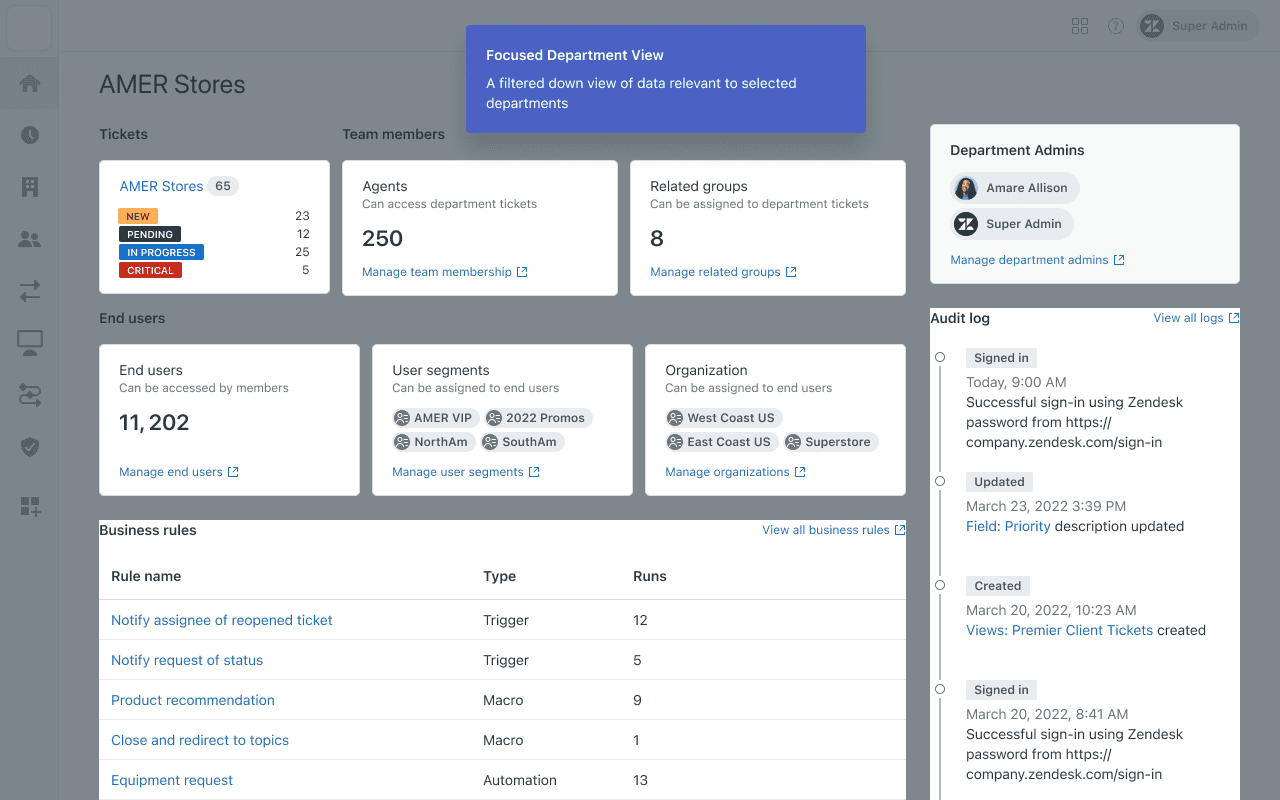
delegate administrative tasks across departments

reflections
This is the most complex and expansive product area I've had the opportunity to work on, along with the fastest deadline I've had to meet as a design lead. The experience put my relationship-building to the test, especially in the first 4 weeks. Naturally we feel pressure to prove that we can adapt quickly to new problem spaces. In this case, coming in with a learning mindset helped me learn the space with agility and get to know the new team.
While we were able to deliver this new level of structure, we needed to address the learnability of the new architecture. Having more options to configure meant it was more challenging for customers to investigate permission-related issues. This immediately rose to the top of our team's priorities as the next step to pursue.
other full case studies
Enhancing the foundational permissions architecture for Enterprise customers.
0→1 security feature to protect consumer data.
© 2026 Designed and built by Nica