full case study
Architecting trust that scales globally and across industries
My role
Design Lead
Research, Vision, Strategy
Core partners
1 Sr. Product Director
1 Principal PM
1 Group Tech Lead
6 Engineers
1 Content Designer
Teams involved
18 org-wide teams (Product, Marketing, Security)
3 product designers
I joined this initiative after initial research had been conducted by a previous designer. I refined the lo-fi designs I inherited into an early access experience within 4 weeks while leading continued research to define a hi-fidelity vision. Making changes to foundational architecture is no small feat that required close collaboration with the product and tech leads to ensure we delivered the most important value and come up with an iterative strategy.
glossary
Customer
A company/business that has purchased Zendesk
Team members
Admins or agents that deliver customer support to end users.
End users
Our customers' customers who submit support requests.
Instance
A Zendesk account used by companies
Brand
A legacy object that has existed in the architrecture
Department
The enhanced partitioning object based on what was previously called Brand
enterprise operation needs
Customers want to scale their setup according to their complex operations but feel limited by the lack of solutions that ensure data and access compliance.
Prior research revealed key insights on where the gaps are when it comes to helping customers scale operations.
A need for external and internal support
Companies want to use their operations for both external consumers and internal employee support such as HR, IT, and Finance.
Global footprint = strict data compliance
They either support global consumers or employ a globally dispersed workforce. Regulations such as GDPR mean they need to ensure only the right agents access consumer data.
Unnecessary administrative overhead
As a workaround, customers resorted to managing multiple instances. This entails additional overhead and inefficient setup.
“
I had to create 12 different instances to achieve what we needed for our operations
– Enterprise customer

department spaces: a multi-year vision
Department Spaces: Enable customers to meet their complex needs through data partitioning.
The main challenge was to build more flexibility to the permissions architecture. We want customers to have more control over what their team members can access, so they can confidently secure their end user data.

co-designing the vision with customers
For continued research, we put our focus on our customers located in EMEA who are required to adhere to stricter data regulations. We traveled to London and invited premier accounts to a co-design workshop. The goal was to validate table-stakes prioritization and create a shared vision of Department Spaces with a diverse set of customers in the region.

Identifying table-stakes
We used this time to re-validate what's been scoped for the early access experience. We wanted to ensure we deliver the most value as the first release of Department Spaces. This session solidified Ticket partitioning as the top priority.

Defining the ideal customer vision
The main question I posed was: "What is your ideal access setup?" All participants converged on a Command Center concept that includes a comprehensive view across all departments while having granular control over delegating users, objects, and rules across.

Bringing teams together for table-stakes
With a clearer vision concept, we then prioritized our time to focus on the delivery of Ticket partitioning for an early access release. We had to partner with 18 different teams to deliver this first phase. Immediately the challenge we ran into was onboarded everyone to the complex world of permissions.
visualization of permissions architecture
The existing architecture is complex and dispersed through 6 pages between 2 product areas. Knowledge sharing was very tedious and involved logging in and out of admin and agent accounts to present the multi-sided experience. There were several attempts to visualize the logic in hopes of asynchronous learning, but it was clear that seeing the behavior from configuration to agent experience is what worked best.
examples of diagrams created


To address this, I created the Ticket Access Simulator– a Figma prototype that allows people to apply permission configurations side-by-side with real-time results. This significantly eased the learning curve for new teams and allowed partner teams in different time zones to onboard independently.
The simulator was also reused later for sprint grooming rituals and became a skill-share session for the design team.
ticket access simulator prototype
advanced prototyping with figma variables skill-share
phase 1: addressing product debt
A core part of our solution is to revamp a legacy object in the architecture called "Brand." It's one of the older pages in the UI and that does not bring significant value to customers. The first step towards Department Spaces is to address the existing product debt to set a foundation for a new permission capability.
before

after
phase 2: ticket access by department
Next is to introduce a new capability that allows customers to assign team members to a brand, so they can only access tickets within brands they are part of. This involved 3 other designers to come up with design solutions. My role here was to lead and ensure the three streams of work use consistent patterns and align with the overall vision.
early access experience


patterns designed across 3 designers


feature adoption results
We released the table-stakes capabilities as part of our early access program. We achieved 8 times the original adoption goal and even had to close sign-ups due to the overwhelming interest.
This led to an equally successful general access, where we're tracking ahead of our adoption targets and have been adopted by customers whose accounts total to 44 million ARR.
8x
early adoption
44M
total adopted customer arr
the final north star
To maintain momentum, my product partner and I continued to refine the vision defined in our co-design workshop. We knew taking on a re-architecturing project would entail iterative efforts over several years. We made sure to have a living north-star vision documented that we continue to re-validate and re-assess. We've broken down the vision and prioritized which parts will bring the most value and keep adjusting based on new learnings.
department spaces: command center

switch to granular department views

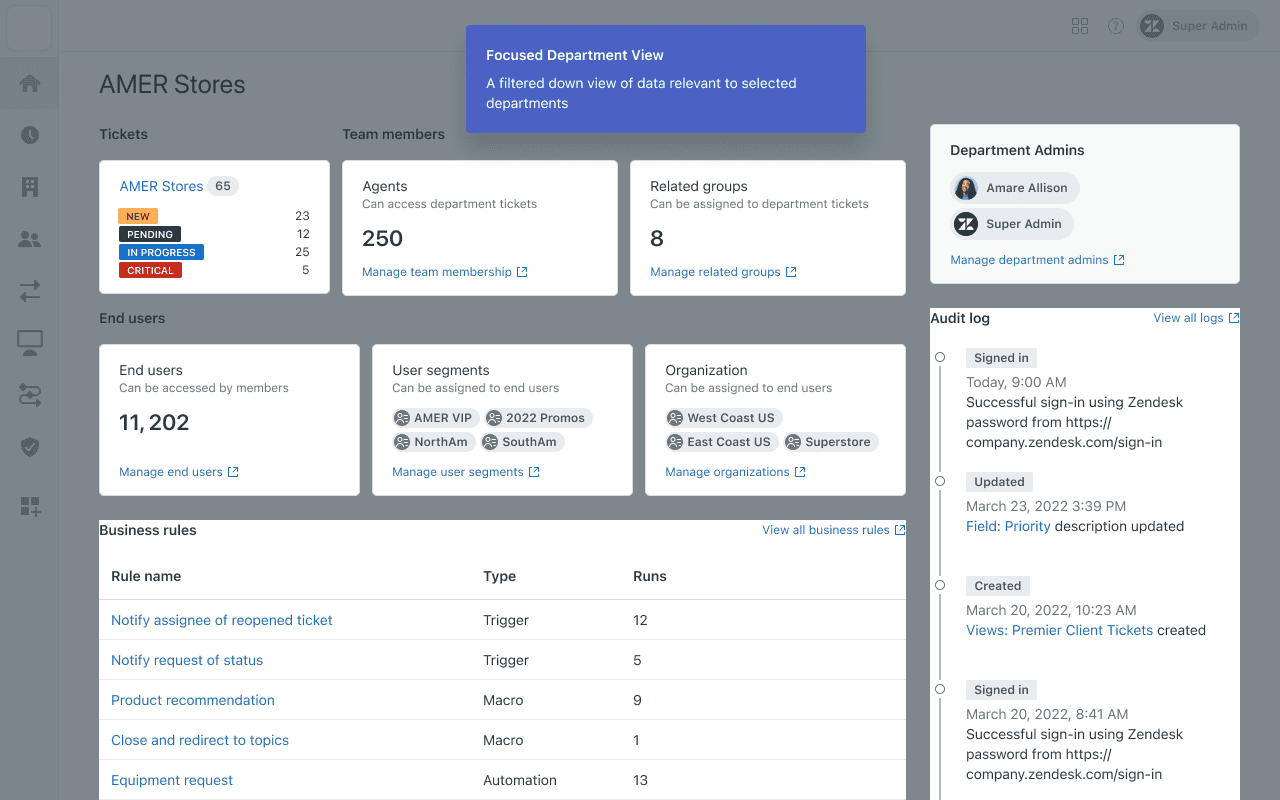
delegate administrative tasks across departments

reflections
This is the most complex and expansive product area I've had the opportunity to work on, along with the fastest deadline I've had to meet as a design lead. The experience put my relationship-building to the test, especially in the first 4 weeks. Naturally we feel pressure to prove that we can adapt quickly to new problem spaces. In this case, coming in with a learning mindset helped me learn the space with agility and get to know the new team.
While we were able to deliver this new level of structure, we needed to address the learnability of the new architecture. Having more options to configure meant it was more challenging for customers to investigate permission-related issues. This immediately rose to the top of our team's priorities as the next step to pursue.
© 2026 Designed and built by Nica